
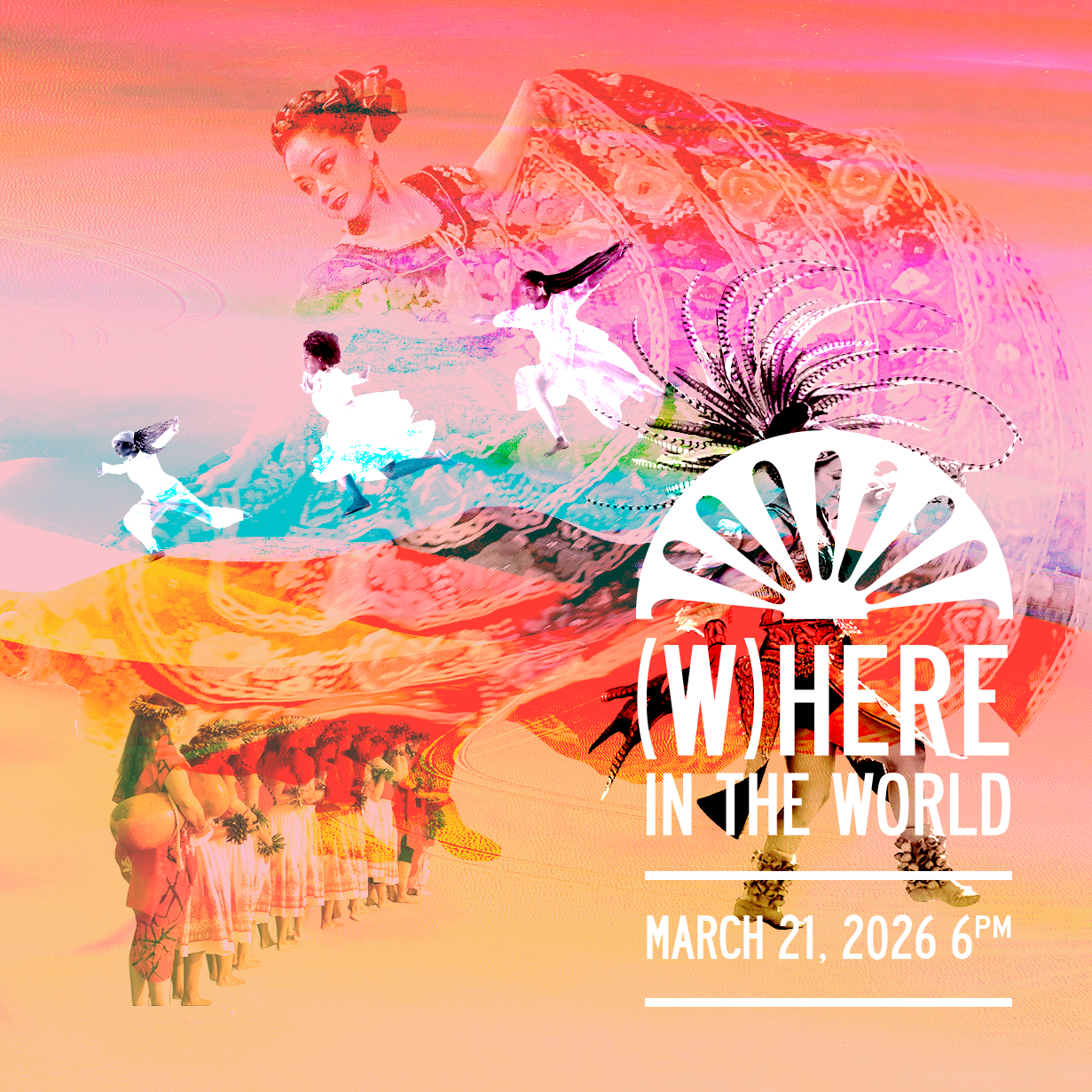
Welcome to (W)here in the World!
Thank you for joining us.
Tonight’s performance will run about 75 minutes with no intermission.
WELCOME - Kerensa DeMars, Artistic Director
1. Procession
Each company represented in this year’s festival joins together to celebrate our music and dance traditions and honor our ancestors. The procession incorporates the four elements, creating a sacred space for performance and celebrating that which unites us.
2. Nā Hale Cultural Arts - Hula Kahiko (Ancient Hula Procession)
Prior to Western Colonization, Hula was a sacred dance, honoring many aspects of life, including, nature, ancestral lineages, and our connection to the divine. The procession has five sections:
Conch Blowing honoring Nature, humanity, spirit.
Kunihi Ka Mauna (Steep Stands the Mountain)- is a permission chant commonly used in ancient hula; and an excerpt from the saga of the fire Goddess, Pele and her beloved sister, Hi'iaka, a major patron goddess of hula.
Ho'opuka e Ka La e Ma Kahikina (The Sun Rises in the East)- this common entrance hula is not only ancient, but deeply rich in metaphor and imagery; comparing the dancers to the graceful 'iwa bird, as they proceed towards the rising sun.
Kamali'i O Ka Po (Child of Night) - also refers to the same person, 'a child of light' and the different aspects of both humanity and divinity. This mele (song) speaks of the balance of the masculine and the feminine, earth and sky, the divine messages and mortal understanding, life and death, and how one chooses to interpret ancestral knowledge and pass it on to those who come after.
Ho'i e Ho'i La (Return, return) - This exit dance is common in ancient hulas, is layered in meaning and invokes majestic imagery of a flock of birds returning lovingly to their upland homes.
3. Ometochtli - Aztec Dance
Aztecs used to dance as a part of a ceremony to connect with and honor our ancestors, Mother Earth, the universe and themselves. Aztecs connect and ask permission to dance to the four winds: East, West, North and South. The movements in the Aztec dance represent the four elements: Water, Earth, Air and Fire. The Aztec drum, known as “huehuetl” leads dancers as if it were the heart of planet Earth beating from deep underground. You may notice that all the steps start with the left foot because our hearts sit on the left side of the body. It is a way to show respect and love.
4. Nā Hale Cultural Arts - Kaulana Na Pua
Kaulana Na Pua is one of Hawaii's foremost songs of resistance against colonization. Written in 1893 during the United States overthrow of the Hawaiian kingdom, this mele (song) instills pride, love and courage to Kanaka Maoli (the Native Hawaiian people). It is choreographed as an 'auana (modern hula), as it incorporates Western instrumentation.
5. Prince Adrean & Company - Asé: The Calling
Asé: The Calling takes audiences on a journey into the life of choreographer Prince Adrean during a season of hardship, as he navigates the early stages of adulthood, self-doubt, and a fractured sense of identity. Confronted by four ancestral spirit guides, he is reminded of his purpose and called back into alignment with his path. This work premiered at the Dance Center of Columbia College Spring Faculty/Student/Alumni Concert “Delve” in May 2025.
6. Nā Hale Cultural Arts - True Colors
"True Colors" not unlike many contemporary Hawaiian hits, is a remake of the famous American pop standard. Sung in both English and 'Olelo Hawai'i, it is a reminder that as indigenous Hawaiians, we are still here, and our hearts and spirits dance in both modern and ancient spaces.
7. Ometochtli Mexican Folk Dance - Chiapas
Chiapas is a souther state in Mexico rich in traditions. One of the most typical folklore dresses is from Chiapas de Corzo - floaty, colorful and flashy. The dresses contain many hand embroidered flowers and one single dress can take up to fifty hours of work to create.
8. Studio K Flamenco and Ometochtli - Encuentro
This duet features Kerensa DeMars and Alejandra Jiménez in a celebration of the music and dance traditions shared by Mexican Folk dance and Flamenco.
9. Ometochtli Mexican Folk Dance - Guerrero
Guerrero is located in southwestern Mexico, a warm state by the Pacific Ocean. “Sones de Tarima” from Tixtla are representative of this state. Dancers use a “Paliacate” to make “floreos” with their hands. This hand movement is a way to communicate with partners, and with the audience. For example, when the paliacate moves to the right, dancers move to the right, or if it moves to the left, dancers move to the left. If the paliacate is up and spinning it signifies a turn, etc.
10. Studio K Flamenco - Raices
Flamenco guitarist Evan Christian and dancer Kerensa DeMars bring the dynamic rhythms and spontaneity of Flamenco to the stage in this suite of three pieces including the Solea (known as the mother of all Flamenco forms), the Solea for Bulería (known as one of the most intense and powerful styles in Flamenco) and the Bulería (known for its intensely fast 12 count rhythm). The piece is called Raices (Roots) in homage to the artists’ greatest influences - Sabicas and Carmen Amaya. You may notice the intense communication between guitarist and dancer as they create the rhythms together, interspersed with spontaneous improvisational sequences.
11. Ometochtli Mexican Folk Dance - Jalisco
Jalisco is located in western Mexico by the Pacific Ocean and is well known for music and dance traditions. Jalisco’s folk dance involves swirling large skirts with the arms to create a pleasing undulating pattern, like the waves in the Pacific Ocean. Jalisco’s traditional outfits are charros for men and colorful dresses for women. Each step is a symbol of pride, identity, and celebration.
12. Nā Hale Cultural Arts - Ori Tahiti
Ori Tahiti, or the ancestral dances of the Tahitian islands, incorporates multi-faceted rhythms in the drum ensemble. Unlike Hula, Tahitian story telling can commonly take place without the use of lyrics. "Ori Nā Hale" (Dance of Many Houses), was composed and choreographed in honor of our cultural arts center, and also pays homage to the elements. "E Piko" is a classic Tahitian folk song choreographed in 'aparima' style, which means kiss of the hands, and incorporates stringed instruments.
13. Ko-Thi Dance Company and Ton Ko-Thi - Spirit of the Harvest/Kassa Konkoba
Spirit of the Harvest explores the communal practice of harvest within the Malinke traditions of Guinea and Mali. Rooted in the rhythms of Kassa and Konkoba, the work reflects the ways music and dance support and celebrate the labor of farmers. These rhythms guide the journey of the harvest season from traveling to the fields, breaking the earth, gathering the crops, and ultimately celebrating the fruits of the community’s labor. Choreography by Adrean Maxwell. Orchestrated by Deonte Ellis and Adrean Maxwell.